


The International Campaign for Tibet (ICT) has analyzed images released recently by the Communist Party’s United Front Work Department from the southern Tibetan town of Tsona (Chinese: Cuona) close to the Indian border. The photographs depict deeply troubling scenes of indoctrination. Tibetan kindergarten children dressed in camouflage uniforms march under the Chinese flag and participate in simulated combat exercise. The children carry imitation rifles for the activities described by Chinese state media as “immersive and distinctive national defense and ethnic unity-themed educational activities.”
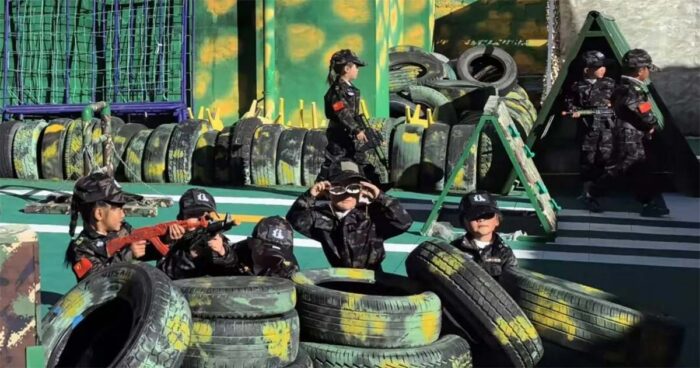
The images were published on May 26, 2026 in a report by the CCP’s United Front Work Department on state media. The report, titled “Nurturing a Love for the Country, Children Guard the Border—Tsona City Kindergarten Holds Educational Activities on National Defense and Ethnic Unity,” openly highlights these activities as a model initiative.
According to the report, the stated objective of the training activities is to instil in young children “a sincere love for the Party, the country, and their hometown,” alongside “a commitment to defending the border.” The program further aims to “advance early childhood national defense education” and strengthen “ethnic unity education.”
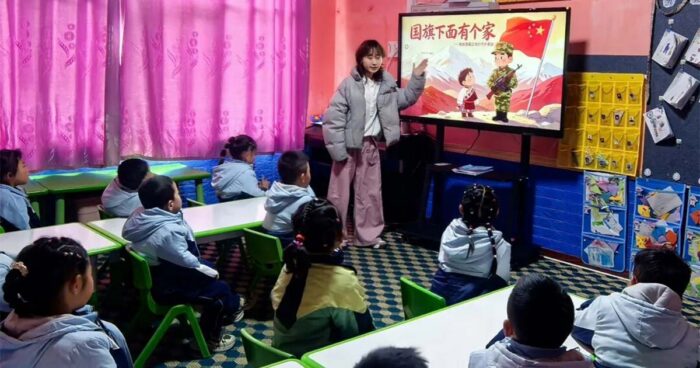
ICT strongly condemns these practices. “The images from Tsona are deeply disturbing. No child should be subjected to military-style training or made to simulate combat—especially not in kindergartens,” ICT said.
Beyond the militarization itself, ICT emphasizes the broader context of systematic ideological indoctrination. Tibetan children are not only exposed to military imagery and discipline at an early age; they are also subjected to state-driven narratives on “ethnic unity.”
“What makes this even more alarming is that these children are simultaneously being indoctrinated with political ideology that threatens the survival of Tibetan culture,” ICT added. “In a border region such as Tsona, this also intersects with China’s assertive posture toward India, raising further concerns about the instrumentalization of children in state narratives.”
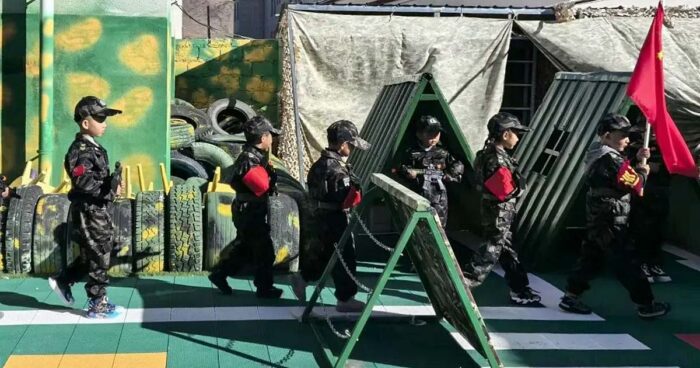
The developments in Tsona are not isolated. ICT has documented a broader pattern of expanding militarization and of indoctrination in Tibetan education systems. Reports indicate that military drills and political training have increasingly been introduced in primary schools and even extended into students’ holiday periods.
These latest images serve as a stark illustration of what ICT describes as the defining features of Chinese Communist Party rule in Tibet: indoctrination, militarization, and repression—reaching even the youngest members of society.
ICT calls on governments, businesses, and civil society actors worldwide to address these abuses directly with Chinese authorities.
“The international community must not be under any illusions about the nature of CCP policies in Tibet,” ICT stated. “The treatment of Tibetan children demands urgent attention and action.”