


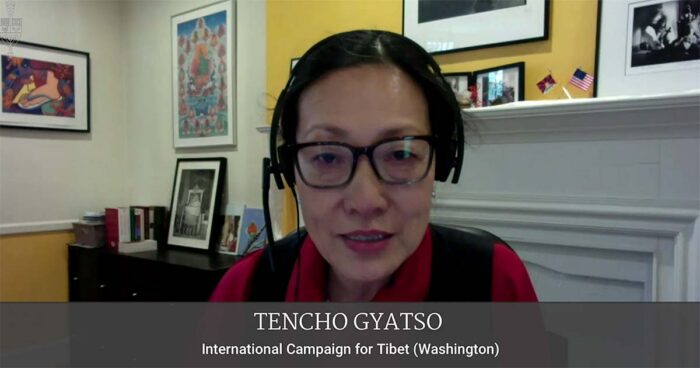
International Campaign for Tibet (ICT) President Tencho Gyatso testified on June 8 before the Canadian House of Commons’s Subcommittee on International Human Rights of the Standing Committee on Foreign Affairs and International Development, urging Canadian parliamentarians to take stronger action against China’s intensifying campaign of forced assimilation in Tibet.
The briefing was held pursuant to a September 23, 2025 motion adopted by the Standing Committee on Foreign Affairs and International Development and a May 25, 2026 motion adopted by the Subcommittee on International Human Rights to examine the situation of Tibetan children placed in schools administered by the People’s Republic of China.
Gyatso appeared alongside Chemi Lhamo, a Tibetan-Canadian human rights activist; Dr. Gyal Lo, Tibet specialist and educational sociologist; Lhadon Tethong, co-founder and director of Tibet Action Institute; and Tenzin Choekyi, senior researcher at Tibet Watch.
In her testimony, Gyatso warned that Beijing’s new “Ethnic Unity and Progress Law,” due to enter into force on July 1, and China’s state-run boarding school system pose a direct threat to Tibetan language, religion, culture and identity.
“The new law makes the state’s ambitions unmistakably clear, laying a stark blueprint to erase Tibetan language, culture and identity,” Gyatso told the subcommittee.
She warned that China’s Ethnic Unity Law could also have consequences beyond China’s borders, creating a framework through which criticism voiced in democratic capitals could be portrayed as undermining “ethnic unity.”
“The tragedy unfolding before our eyes in Tibet is therefore not only a Tibetan tragedy — it is a human tragedy,” Gyatso said.
Gyatso urged Canadian leaders to take three concrete steps: publicly condemn the Ethnic Unity Law and press Prime Minister Mark Carney and Foreign Minister Anita Anand to do the same; demonstrate support for Tibetans through high-level engagement with the Central Tibetan Administration and Sikyong Penpa Tsering; and work with democratic partners to ensure that the succession of the Dalai Lama is respected as a matter for the Tibetan Buddhist community alone to decide, free from Chinese government interference.
“The issue concerning the 15th Dalai Lama does not belong to the Chinese Communist Party but to Tibetans alone,” she said.
ICT has warned that China’s assimilation policies are part of a systematic effort to weaken Tibetan identity and consolidate Communist Party control over every aspect of Tibetan life. The organization continues to urge democratic governments to coordinate responses, press China to end coercive policies in Tibet, support meaningful dialogue between Chinese officials and Tibetan representatives, and protect the rights of Tibetans inside Tibet and in exile.
As Gyatso told Canadian lawmakers, international leadership matters “for Tibet … for we want our future generations to have a Tibet to inherit, and not one remembered only through photographs, archives and exile.”